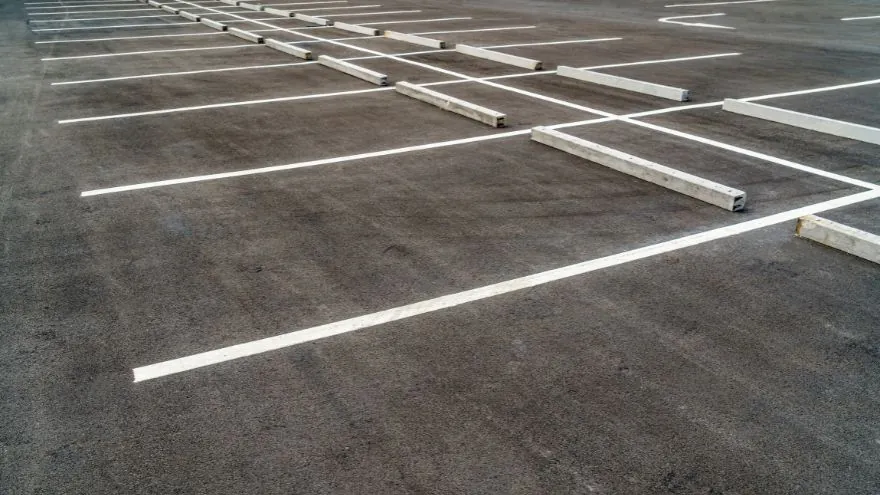
Parking lot striping determines how many revenue-generating spaces fit in your available square footage. Poor layout wastes space. Optimized striping can increase capacity by 15-30% on the same footprint, directly impacting revenue without requiring property expansion.
Standard vs Compact Space Sizing
Standard parking spaces measure 9 feet wide by 18 feet deep. Compact spaces measure 8 feet wide by 16 feet deep. A lot with 100 standard spaces might fit 115-120 compact spaces in the same area.
Mixed layouts balance capacity and usability. Designate 60-70% of spaces as standard and 30-40% as compact. This accommodates all vehicle types while capturing capacity gains.
Track your actual vehicle mix over 2-3 weeks to determine optimal ratios for your location.
Angle Parking vs Perpendicular Parking
Perpendicular (90-degree) parking maximizes spaces in rectangular lots. Angle parking (45-60 degrees) works better in lots with one-way traffic flow and irregular shapes.
Calculate actual capacity for your specific dimensions. A 200-by-150-foot lot might fit 95 perpendicular spaces or 88 angled spaces. Perpendicular generates more revenue despite requiring more careful parking.
Angle parking reduces accidents and speeds throughput in high-turnover retail operations. Office lots maximize revenue with perpendicular layouts.
Traffic Flow and Drive Aisle Width
Two-way traffic requires 24-foot drive aisles for perpendicular parking. One-way traffic allows 12-14 foot aisles, freeing space for additional parking rows.
Converting to one-way circulation can add 10-15% capacity. However, one-way flow increases drive distance for customers. Properties with multiple entrances support one-way flow better than single-entrance lots.
When to Re-Stripe for More Spaces
Re-striping makes sense when current layout wastes space or uses outdated sizing standards. Lots striped 20+ years ago often use 10-foot wide spaces when 9-foot spaces meet current standards.
Narrowing spaces from 10 feet to 9 feet across a 100-space lot potentially adds 10-12 spaces. At $8 average daily revenue, those additional spaces generate $24,000-29,000 annually.
Re-striping costs $0.75-2.50 per linear foot. A complete re-stripe averaging $3,000-8,000 pays back in 3-6 months through added capacity.
ADA Requirements Impact Layout
Accessible spaces and access aisles consume more square footage than standard spaces. Plan ADA spaces into your layout from the start rather than retrofitting.
Adding 10 spaces through re-striping might trigger the need for one additional accessible space. Factor this into capacity calculations.
Repainting Schedule and Maintenance
Line visibility directly impacts compliance and customer experience. Faded lines create confusion about space boundaries, leading to poor parking that reduces effective capacity.
Re-paint lines every 18-24 months in high-traffic lots. Lower-traffic lots can extend to 36 months. Use high-durability paint or thermoplastic striping in heavy-use areas for longer service life.
Budget $0.40-0.80 per linear foot for repainting existing lines versus $0.75-2.50 for complete re-striping with layout changes.
Parking lot layout and striping directly control how many revenue-generating spaces fit your property, making design optimization one of the highest-return improvements available.