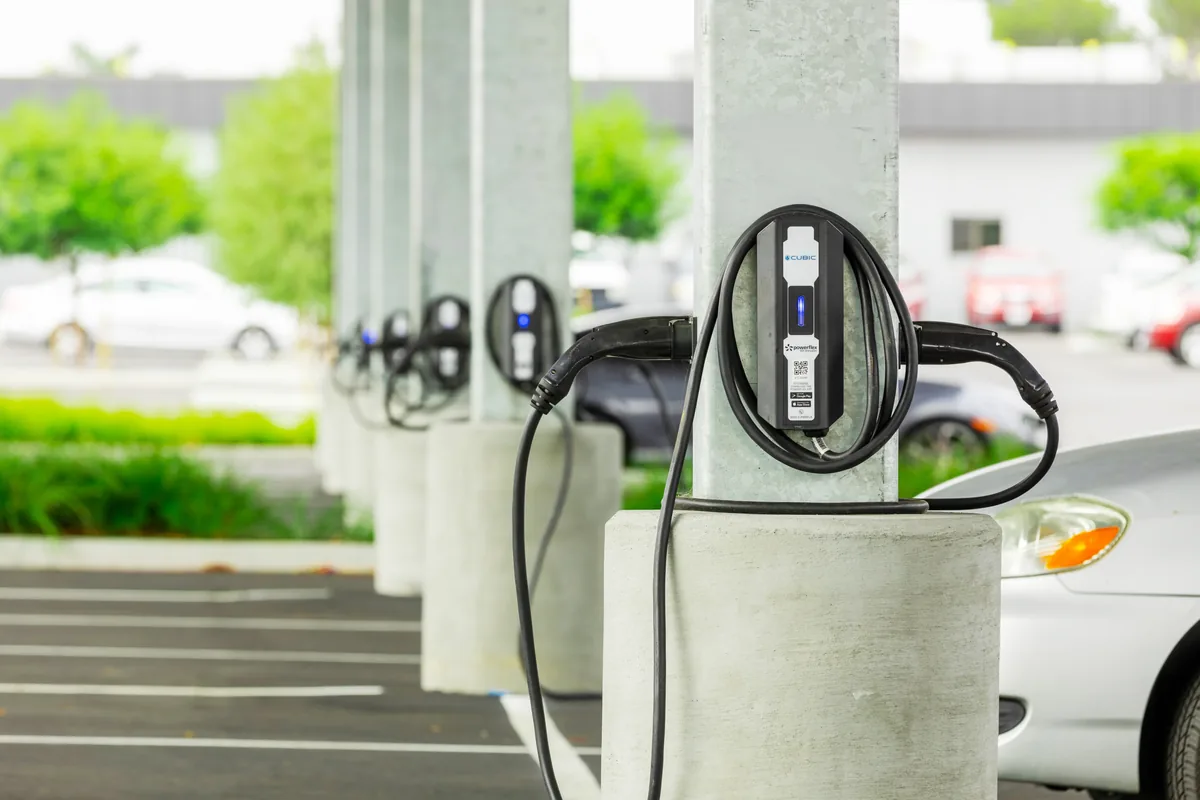
Property owners exploring EV charging quickly run into two very different business models. One requires no upfront investment and shares revenue with a charging network. The other requires full capital outlay and keeps every dollar the chargers generate. Both can work, and the right choice depends on capital availability, risk tolerance, property profile, and how involved the owner wants to be in day-to-day operations.
For most property owners, the question is not which model produces the highest theoretical return. It is which model produces the best risk-adjusted return given real-world utilization, operational capacity, and the cost of tied-up capital. For context on how charging revenue stacks with parking income, the article on EV charging and paid parking revenue walks through the combined revenue math.
How the Revenue Share Model Works
Under a revenue share arrangement, a charging network provider installs and owns the equipment. They handle permitting, installation, software, payment processing, maintenance, and equipment replacement. The property contributes the location, the electrical capacity, and the parking spaces.
In exchange, the property receives a percentage of the revenue generated by the chargers. Splits vary based on deal structure, location quality, and projected utilization.
The appeal goes beyond avoiding capital outlay. The property transfers nearly every operational risk to the network provider. Equipment failures, software issues, payment disputes, and replacement cycles become someone else's problem. Revenue starts flowing once the chargers are live, and the property never writes a check for repairs or upgrades.
How the Ownership Model Works
Under the ownership model, the property buys the equipment, pays for installation, and operates the chargers directly. The owner keeps 100% of the gross revenue and controls pricing, policies, and operations.
Capital requirements vary widely. A small Level 2 deployment might run $20,000 to $50,000 all-in. A DC fast charging project can exceed $300,000 per port. Ongoing costs include software subscriptions, maintenance contracts, electricity, payment processing, and eventual equipment replacement at year 7 to 10.
The reward is full revenue capture. The tradeoff is upfront cost, operational responsibility, and exposure to underperformance if utilization comes in below projections.
The Real Financial Picture
The headline math on ownership looks attractive. Keeping 100% of revenue beats keeping a percentage. But headline math leaves out the costs that make ownership harder than it appears.
A Level 2 port under ownership generates gross revenue, then loses money to network software fees, payment processing, maintenance, electricity costs, insurance, and a replacement reserve. Net revenue typically lands 30% to 50% below gross once everything is accounted for honestly. Many owners skip the replacement reserve entirely, which makes year-one returns look better than they actually are over the equipment lifecycle. The costs that get left out of ownership pro formas are the same ones covered in the hidden costs of EV charging installation.
Revenue share simplifies this. The percentage the property receives is net. There are no surprise repair bills, no demand charge spikes, no software subscription increases, and no equipment replacement costs in year 8. The number on the monthly statement is the number that hits the bank account.
For properties with uncertain utilization, this predictability matters. An ownership model that pencils out at projected utilization can lose money at actual utilization. A revenue share model produces proportional returns regardless of how the chargers perform.
Why Revenue Share Fits Most Properties
Several factors push most properties toward revenue share as the default starting point.
Capital efficiency is the biggest. Money spent on EV charging equipment is money not spent on other property improvements, debt reduction, or acquisitions. Even properties with available capital often find better returns deploying it elsewhere while letting a charging partner fund the EV infrastructure.
Risk transfer is the second factor. EV charging is still a maturing market. Utilization patterns shift, technology evolves, and equipment standards change. Owning hardware in a fast-moving category exposes the property to obsolescence risk that revenue share partners absorb.
Operational simplicity is the third. Most property owners are not in the EV charging business. Adding a new operational discipline, with its own vendor relationships, maintenance schedules, and customer service issues, distracts from core property management. Revenue share keeps the property focused on what it does well.
Speed to market is the fourth. Revenue share deployments often move faster because the network handles permitting and utility coordination as part of their standard process. Ownership projects depend on the property managing those steps directly, which extends timelines.
When Ownership Makes Sense
Ownership still has a place for the right properties.
Very high traffic locations with proven utilization can justify the capital outlay because the breakeven arrives quickly. Properties that already operate paid parking systems sometimes prefer ownership for integration reasons. Owners with strong appetite for operational control and long hold horizons can make the math work.
These situations exist, but they are the exception rather than the rule. Most properties are not high-traffic flagship locations. Most owners do not want another operational category to manage. Most hold periods are not long enough to capture full lifecycle returns on owned equipment.
For those properties, revenue share is not a compromise. It is the better business decision.
Contract Terms That Matter
Within revenue share agreements, the terms vary and the details affect the actual value.
Length of term, revenue calculation methods, exclusivity provisions, and exit rights all shape the deal. A higher percentage with restrictive terms can be worth less than a lower percentage with clean provisions. Strong revenue share partners are transparent about how revenue is calculated, what fees are deducted before the split, and what happens at the end of the term.
Owners signing revenue share contracts should review them with the same care as any long-term agreement. The model is simple, but the contract still deserves scrutiny. A focused walkthrough of the questions property owners should ask before signing an EV charging contract is a good starting point.
Match the Model to the Property
The revenue share versus ownership question deserves a real analysis rather than a default answer. For most properties, revenue share produces better risk-adjusted returns, faster deployment, and fewer operational headaches. For a smaller set of properties with the right profile, ownership captures more value.
A vendor-neutral analysis looks at both options, runs the numbers honestly including all the costs ownership often hides, and recommends the model that fits the property.